


Is it possible to sleep without having any dreams?
Jul 09, 2026
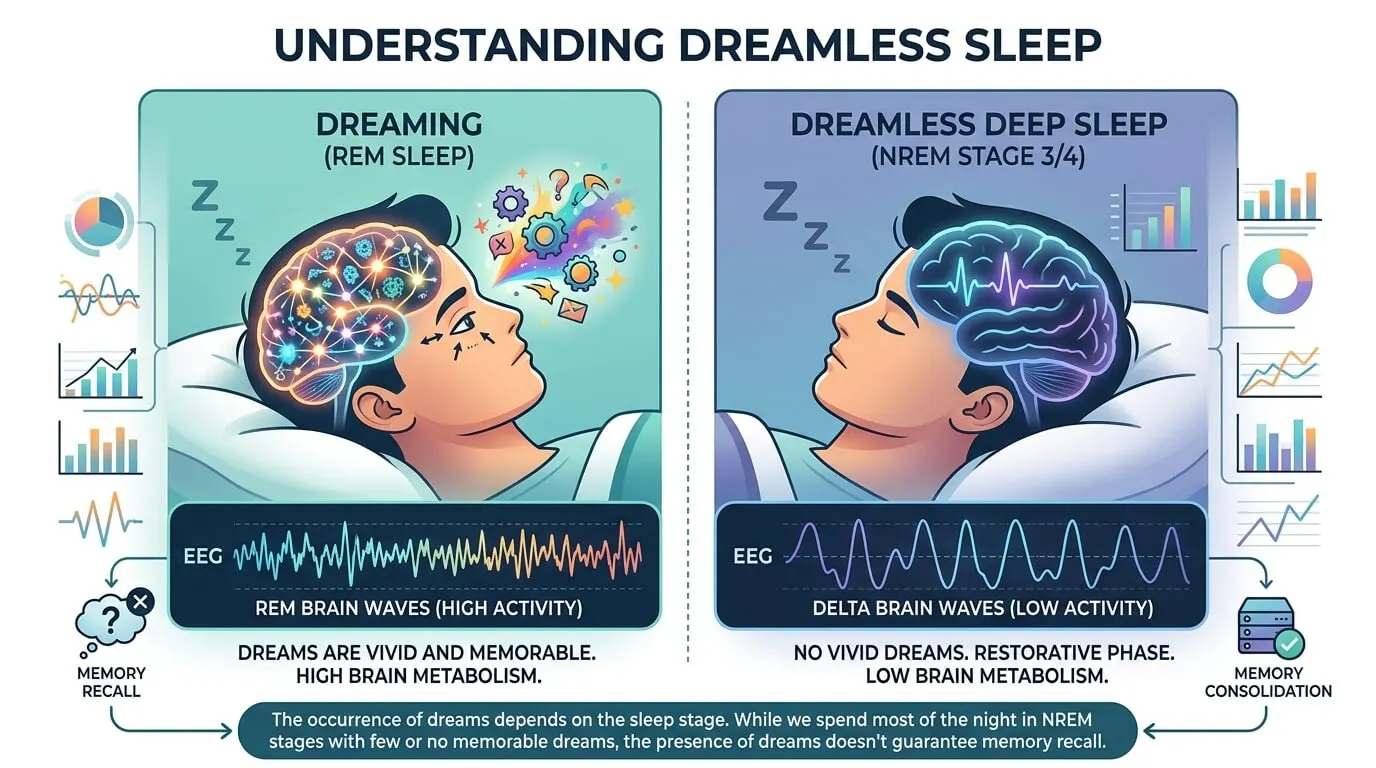
Every morning, millions of people wake up with a completely blank canvas in their memory. They close their eyes, the world goes dark, and they wake up eight hours later feeling like a single minute hasn't passed. Naturally, this leads to a fascinating question: Is it actually possible to have a completely dreamless sleep, or are we just forgetting our nightly adventures?
For decades, science leaned toward a simple answer. But recent advances in neuroscience and sleep tracking have revealed a reality that is far more complex — and a lot more active — than you might think.
The Short Answer: No (With Exceptions)
If you are a healthy human being, you almost certainly dream every single night. The catch is that you simply do not remember the vast majority of them.
Neuroscientists estimate that we spend roughly two hours per night dreaming. If you wake up believing your mind was a quiet, empty void all night, you are experiencing standard dream amnesia, not dreamless sleep.
However, if we are talking about a strict biological absence of the neurological dreaming mechanism, true dreamless sleep is possible under specific medical conditions.
Why You Think You Aren’t Dreaming
To understand why our brains hide our dreams from us, we have to look at how the brain transitions from sleep back to wakefulness.
The primary reason you "don't dream" comes down to brain chemistry. During Rapid Eye Movement (REM) sleep — the phase where our most intense, narrative-driven dreams occur — the brain completely shuts off its supply of norepinephrine. This chemical is essential for paying attention and moving memories from temporary storage into long-term storage.
[Dream Occurs in REM] ──> [No Norepinephrine Available] ──> [Memory Dissolves on Waking]
Unless you wake up directly during or immediately after a dream, your brain lacks the chemical glue required to lock that memory in place. Within 90 seconds of opening your eyes, the memory of the dream dissolves.
The Myth of the "Dreamless" Phase
For a long time, standard science taught that sleep was split into two neat halves: NREM (Non-Rapid Eye Movement) was the quiet, dreamless recovery phase, and REM was the active dreaming phase.
We now know this is a myth.
Studies utilizing high-density EEG (brain wave tracking) have revealed that people dream during NREM sleep too. The difference lies in the style of the dream:
- REM Dreams: Emotional, vivid, bizarre, and structured like a movie. Your brain is highly active, sometimes even more so than when you are awake.
- NREM Dreams: Thought-like, mundane, and static. If you dream in NREM, you might just see a still image of a grocery store shelf or repeat a simple phrase over and over.
Because NREM dreams lack the emotional punch and visual chaos of REM dreams, your waking mind doesn't register them as "real" dreams.
When Sleep Truly Becomes Dreamless
While healthy brains dream constantly, there are specific scenarios where dreaming genuinely stops:
1. Neurological Damage (Charcot-Wilbrand Syndrome)
This rare condition occurs when a patient suffers a stroke or physical trauma to specific visual processing regions of the brain (the inferior lingual gyrus). Patients with this syndrome can sleep normally and enter REM sleep, but they completely lose the ability to generate mental imagery, resulting in a documented, clinical state of dreamless sleep.
2. Medications that Suppress REM
Many common medications, particularly standard antidepressants (SSRIs) and heavy sleep aids, significantly alter your sleep architecture. They can drastically shorten or fragment your REM cycles. While they may not completely eliminate every single dream molecule, they can suppress REM sleep enough to create a fundamentally dreamless night.
3. Severe Sleep Deprivation
When you run on chronically low sleep, your body prioritizes deep slow-wave sleep (N1 and N2 stages) over REM sleep to physically repair tissue and clear metabolic waste. If you are sleeping in short, fragmented bursts, your brain may skip the deep REM cycles entirely.
The Reality Check: If you are sleeping well, waking up refreshed, and remembering zero dreams, don't worry. Your brain is doing exactly what nature intended: sorting your memories in secret and wiping the slate clean so you can face a new day.